Friday, 27 November 2015

DYNAMIC ROUTING FOR DATA INTEGRITY AND DELAY DIFFERENTIATED SERVICES IN WIRELESS SENSOR NETWORKS?

WIRELESS SENSOR NETWORKS


                   Applications running on the same Wireless Sensor Network (WSN) platform usually have different Quality of Service (QoS) requirements. Two basic requirements are low delay and high data integrity. However, in most situations, these two requirements cannot be satisfied simultaneously. In this paper, based on the concept of potential in physics, we propose IDDR, a multi-path dynamic routing algorithm, to resolve this conflict. By constructing a virtual hybrid potential field, IDDR separates packets of applications with different QoS requirements according to the weight assigned to each packet, and routes them towards the sink through different paths to improve the data fidelity for integrity-sensitive applications as well as reduce the end-to-end delay for delay-sensitive ones.


                                   WSNs, which are used to sense the physical world, will play an important role in the next generation networks. Due to the diversity and complexity of applications running over WSNs, the QoS guarantee in such networks gains increasing attention in the research community. As a part of an information infrastructure, WSNs should be able to support various applications over the same platform. Different applications might have different QoS requirements. For instance, in a fire monitoring application, the event of a fire alarm should be reported to the sink as soon as possible. On the other hand, some applications require most of their packets to successfully arrive at the sink irrespective of when they arrive. 

OPTIMAL RESOURCE ALLOCATION IN RANDOM ACCESS COOPERATIVEOPTIMAL RESOURCE ALLOCATION IN RANDOM ACCESS COOPERATIVE COGNITIVE RADIO NETWORKS?

COGNITIVE RADIO NETWORKS

                   Cooperative cognitive radio networks (CCRNs) incorporates cooperative communication into cognitive radio networks, in which, primary users lease their spectrum to secondary users, and in exchange, the primary users leverage secondary users as cooperative relays to enhance their own throughput. Mobile operators offload their Internet traffic to privately owned Wi-Fi access points (APs), much to the inconvenience of non-cellular users served by the APs. However, by employing the CCRN scheme, the mobile operator can lease a licensed channel to the AP, effectively doubling its capacity. In this paper, we propose an implementation of the CCRN framework applied to IEEE 802.11 WLANs.


                                   MOBILE data offload to small cell technology such as Wi- Fi or femtocell provides a compelling solution for mobile operators who want to relieve the strain on their core networks. Compared to cellular macro cells, small cells provide increased spectrum reuse in the coverage area, higher signal to noise ratio in the cell (hence superior link bit rate for its users), and are highly cost effective even for large scale deployments. Furthermore, the reduced transmission times enabled by the superior link bit rates in the small cells directly translate into battery power saving for the user devices. Wi-Fi hotspots operate in the unlicensed bands and suffer from severe interference due to scarce spectrum availability. 

COGNITIVE RADIO-AWARE TRANSPORT PROTOCOL FOR MOBILE AD HOC NETWORKS?

COGNITIVE RADIO


                        Allowing secondary users to choose an available channel from among a wide spectrum range thus enables reliable communication in this context, but communication characteristics such as bottleneck bandwidth and RTT will change with channel switch. In response to this change, TCP has to adaptively update its congestion window (cwnd) to make an efficient use of the available resources. For this purpose, TCP CRAHN was proposed for CogMANET. In this paper, TCP CRAHN is first evaluated in cases where bottleneck bandwidth and RTT drastically change. Based on these results, TCP CoBA is proposed to further improve the throughput of the above use cases. TCP CoBA updates the cwnd based upon the available buffer space in the relay node upon channel switch, as well as other communication characteristics.


                                          Cognitive radio technology has the potential to ameliorate the scarcity of wireless resources because unlicensed users (secondary users: SUs) can use wireless resources only if they have no impact on the operations of licensed users (primary users: PUs). In the future, cognitive radio mobile ad hoc networks (CogMANET) will be constructed from many mobile SUs connected to each other in a distributed manner, which can be deployed for various applications, including intelligent transport systems (ITS).

BRACER: A DISTRIBUTED BROADCAST PROTOCOL IN MULTI-HOP COGNITIVE RADIO AD HOC NETWORKS WITH COLLISION AVOIDANCE?

COLLISION AVOIDANCE


A fully-distributed Broadcast protocol in multi-hop Cognitive Radio ad hoc networks with collision avoidance, BRACER, is proposed. In our design, we consider practical scenarios that each unlicensed user is not assumed to be aware of the global network topology, the spectrum availability information of other users, and time synchronization information. By intelligently downsizing the original available channel set and designing the broadcasting sequences and scheduling schemes, our proposed broadcast protocol can provide very high successful broadcast ratio while achieving very short average broadcast delay. It can also avoid broadcast collisions. To the best of our knowledge, this is the first work that addresses the unique broadcasting challenges in multi-hop CR ad hoc networks with collision avoidance.


Cognitive radio (CR) technology has been proposed as an enabling solution to alleviate the spectrum underutilization problem. With the capability of sensing the frequency' bands in a time and location-varying spectrum environment and adjusting the operating parameters based on the sensing outcome, CR technology allows an unlicensed user(or, secondary user (SU)) to exploit those frequency bands unused by licensed users (or, primary users) in an opportunistic manner. Secondary users can form a CR infrastructure-based network or a CR ad hoc network. Recently, CR ad hoc networks have attracted plentiful research attention due to their various applications. Broadcast is an important operation in ad hoc networks, especially in distributed multi-hop multi-channel networks.

DETECTING A NEIGHBOR NODE LOCATION USING COOPERATIVE NEIGHBOR POSITION VERIFICATION IN VANET?

NEIGHBOR POSITION VERIFICATION


                               Efficient schemes for warning message dissemination in vehicular ad hoc networks (VANETs) use context information collected by vehicles about their neighbor nodes to guide the dissemination process. Based on this information, vehicles autonomously decide whether they are the most appropriate forwarding nodes. These schemes maximize their performance when all the vehicles advertise correct information about their positions, but position errors may drastically reduce the performance of the dissemination process. We present a proactive cooperative neighbor position verification protocol that detects nodes advertising false locations and selects optimal forwarders to mitigate the impact of adversarial users. 


                                  Vehicular ad hoc networks (VANETs) are wireless networks that require no fixed infrastructure and are considered essential for cooperative applications among cars on the road. VANETs have many possible applications, ranging from road safety through cooperative awareness to real-time distributed traffic management. In this paper, we focus on traffic safety and efficient warning message dissemination, where the most critical goal is to reduce the latency while ensuring the accuracy of the information when a dangerous situation occurs. There, vehicles detecting abnormal situations (accident, slippery road, etc.) are deemed to notify the anomaly to nearby vehicles that could face the same problem later on. 

ROFF: ROBUST AND FAST FORWARDING IN VEHICULAR AD-HOC NETWORKS?

VEHICULAR AD-HOC NETWORKS

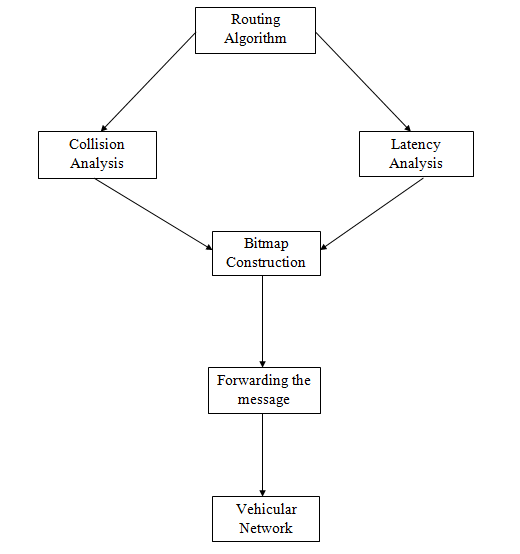
  Many safety applications rely on multi-hop broadcasting to disseminate safety messages. In most existing multi-hop broadcasting protocols, one next forwarder is selected through contention among forwarder candidates based on their different waiting times. In this paper, we first analyze the latency and collision of the existing protocols, and point out two problems: 1) unnecessary delay occurs in the contention process due to the lack of considering the distribution of vehicles and 2) the short difference between waiting times of forwarder candidates may allow redundant broadcasts to collide with each other. Secondly, we propose a new multi-hop broadcast protocol called RObust and Fast Forwarding (ROFF) to mitigate both problems. ROFF solves the first problem of unnecessary delay by allowing a forwarder candidate to use the waiting time which is inversely proportional to its forwarding priority.


A lot of safety applications over vehicular ad-hoc networks (VANET) rely on emergency message dissemination (EMD) through multi-hop broadcast. In EMD, a certain vehicle (i.e. source) issues an emergency message when a dangerous situation such as vehicle collision has been detected. Since the emergency message includes time-sensitive life-critical information, it should be disseminated to all vehicles in the target region as quickly and reliably as possible. Commonly, the target region is a road segment that is up to several kilometers long in the opposite direction of the source.